
Welcome back to my weekly AI digest! This week brought exciting updates across models, tools, and research-and I’ve picked the most interesting highlights for you.
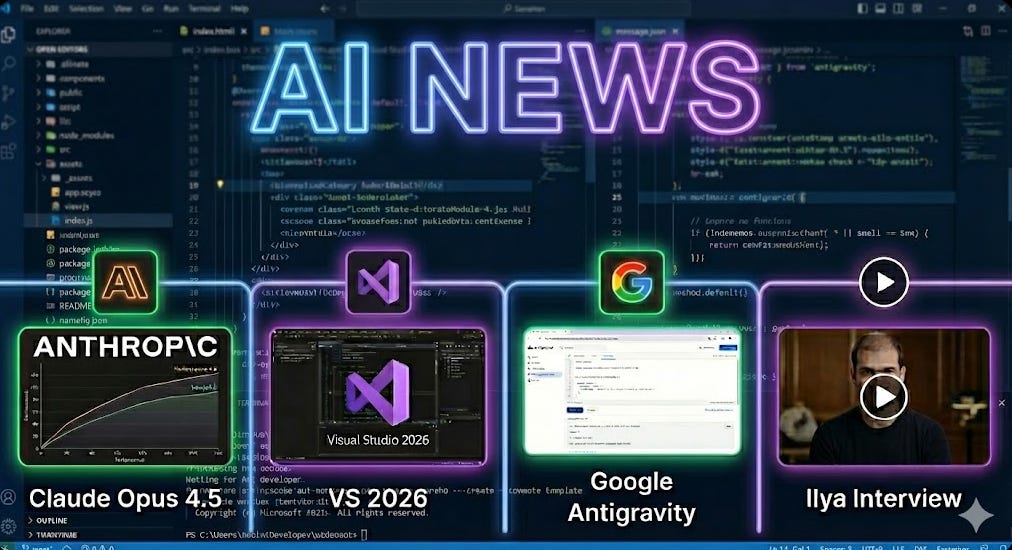
1. Video with Ilya Sutskever (OpenAI co-founder): The Age of Research
Ilya Sutskever discusses a major shift in the industry: we are moving from the “Age of Scaling” (where adding more data/compute automatically yielded better results) to the “Age of Research.” He argues that pre-training data is finite and that future breakthroughs will come from discovering new paradigms-potentially mimicking how humans learn efficiently with limited data-rather than just making models bigger. Watch the video
2. New from Anthropic: Claude Opus 4.5
Anthropic released Claude Opus 4.5. It claims the title of the world’s best model for coding and agents, outperforming Sonnet 4.5, Gemini 3 Pro, and others on benchmarks. The standout feature? The price. Opus 4.5 tokens are significantly cheaper than previous frontier models ($5 per million input / $25 output), making high-end intelligence much more accessible. Read more
3. Microsoft Released Visual Studio 2026
Microsoft has officially launched Visual Studio 2026. This isn’t just an update; it’s a rebuild with AI agents natively under the hood. It features deep integration with GitHub Copilot and new capabilities like “Adaptive Paste,” all while being significantly faster and less prone to freezing than previous versions. Read more
4. OpenAI Develops DeepResearch for Shopping
Just in time for the holidays, OpenAI has launched a “Deep Research” agent specifically for shopping. Unlike a standard search, this agent autonomously browses multiple sites, reads reviews, and synthesizes the information to find the best deals and products for you. It’s a glimpse into how agents will handle complex, multi-step web tasks in the future. Read more
5. Google’s Antigravity IDE
Google dropped “Antigravity,” a new AI-first IDE built around Gemini 3. The “killer feature” here is the agent’s ability to not just write code, but actively test it. It can run your app in browser, interact with it to find bugs, and even record a video of the testing process for you to review. Visit Antigravity or watch my tutorial below.
6. Google Introduces Nested Learning
Google is proposing a new machine learning paradigm called “Nested Learning.” This approach tackles the problem of continual learning by allowing models to integrate new information into an existing knowledge structure without overwriting or “forgetting” what they already know-similar to how humans add to their knowledge base over time. Read the paper
Enjoyed the digest? Subscribe and stay ahead of the latest AI trends. See you next week!