
Hey Devs! Here are the AI updates I picked for this week.
Meta launches AI Mode in Facebook search
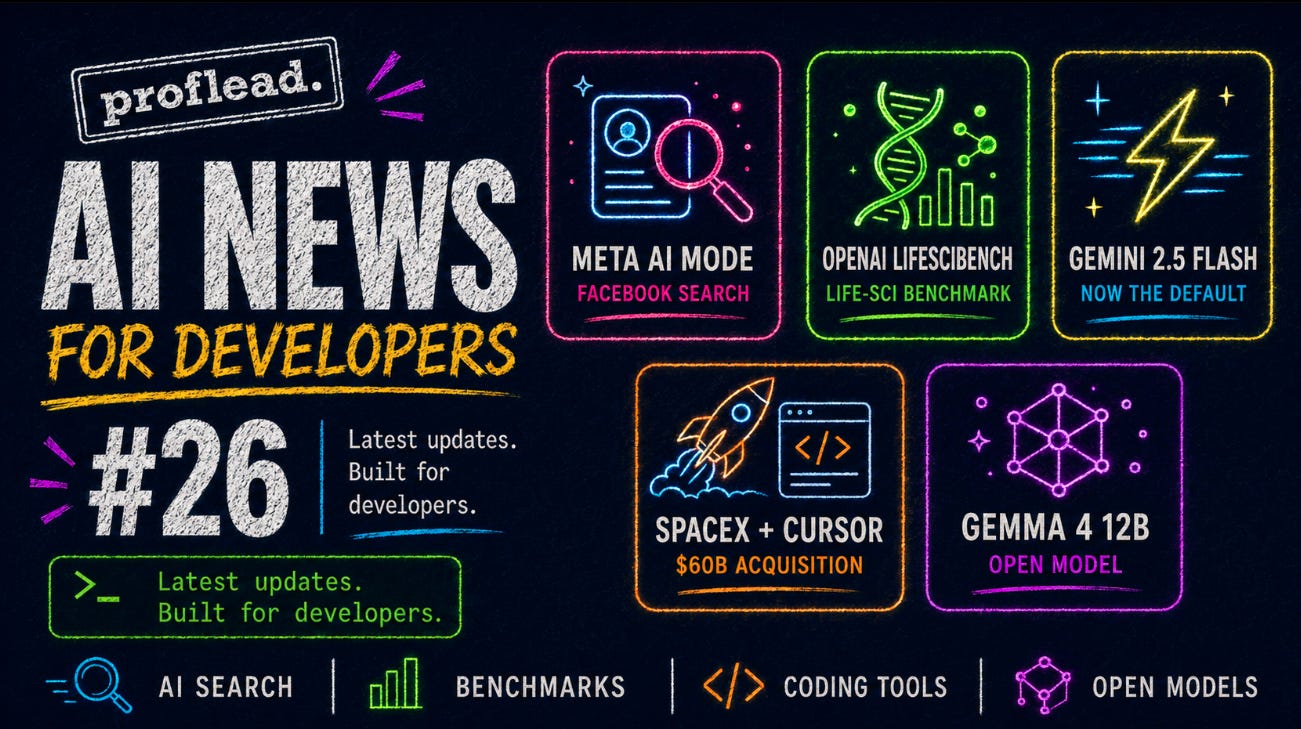
Meta rolled out AI Mode globally on 15 June. It appears alongside existing search options and uses Meta AI to synthesize conversational answers from public posts, Groups, and Reels rather than returning a ranked list of links.
Read more: https://about.fb.com/news/2026/06/new-ai-tools-to-help-you-make-things-happen-on-facebook/
OpenAI releases LifeSciBench
OpenAI announced LifeSciBench, an expert‑written benchmark for life‑science research tasks. It covers 750 tasks across seven workflows and biological domains, involving 1,062 task artifacts, 173 scientist contributors, and 453 expert reviewers.
LifeSciBench could become a reference point for AI systems for biotech and pharmaceutical tasks, reminding developers to consider domain‑specific performance rather than generic metrics alone.
Read more: https://openai.com/index/introducing-life-sci-bench/
Google makes Gemini 2.5 Flash the default
Google replaced Gemini 2.5 Pro with Gemini 2.5 Flash as the default across its consumer Gemini products. Flash is a cost‑optimised model priced at $0.30 per million input tokens, offers an optional thinking mode, and supports a 1 million‑token context window.
SpaceX to acquire Cursor for $60 billion
Days after its record‑setting IPO, SpaceX agreed to buy AI coding startup Cursor (formerly Anysphere) in a $60 billion all‑stock deal. The purchase, set to close in the third quarter of 2026, follows a tie‑up announced two months earlier.
If you use Cursor, watch for changes to its product and model integrations as the acquisition progresses.
Read more:
Google released Gemma 4 12B
Gemma 4 12B, a multimodal model licensed under Apache 2.0 that runs on 16 GB devices and handles text, images, and audio. Cohere shipped its first open‑source coding model at 30 B parameters, and Moonshot’s K2.7‑Code is reported to deliver better coding performance with 30 % fewer reasoning tokens. Roblox open‑sourced a 3‑D‑generation model.
Read more: https://blog.google/innovation-and-ai/technology/developers-tools/introducing-gemma-4-12b/
And that’s it! See you next week! Cheers, proflead! ;)