
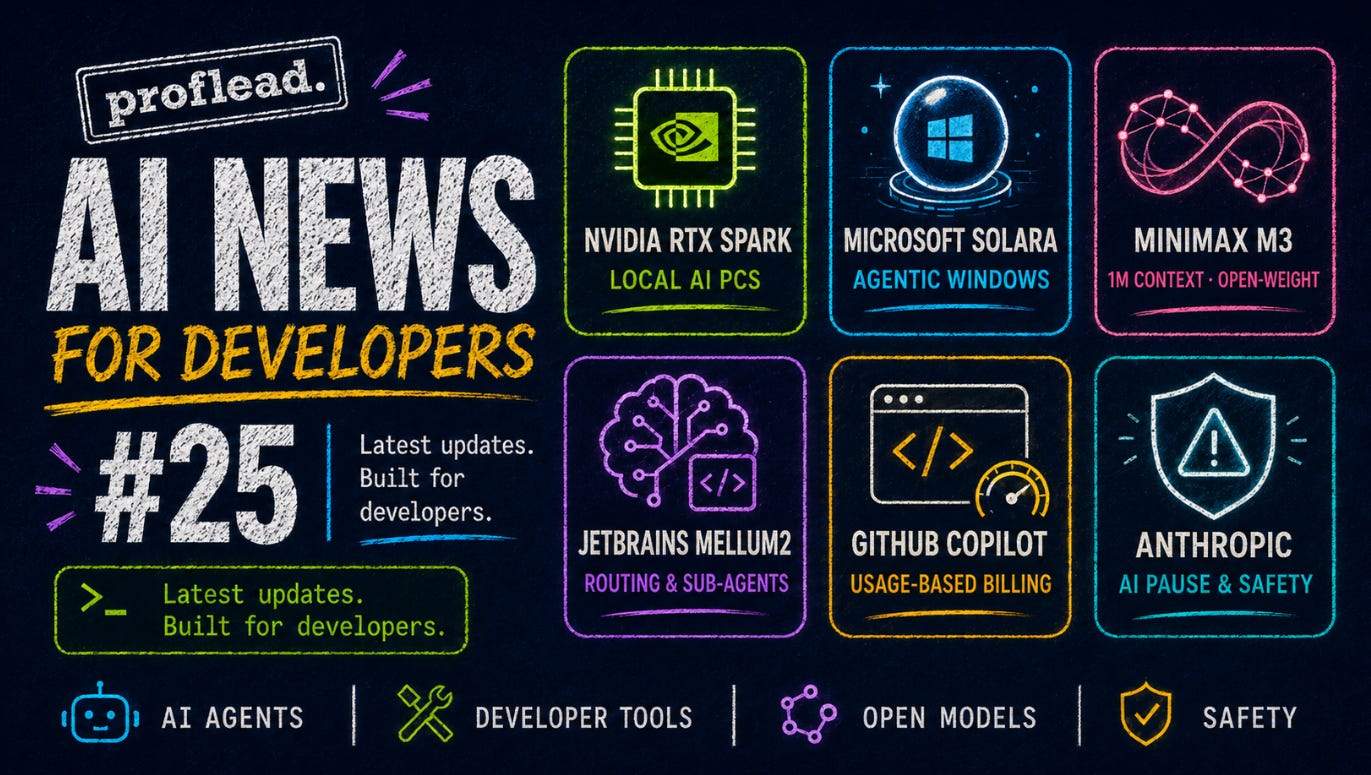
Hey, Devs! Vlad here! For 31 May to 6 June 2026, I picked updates on local AI hardware, open models, Copilot billing, and AI development policy.
Nvidia unveils RTX Spark PC chip for local AI
NVIDIA used Computex to introduce RTX Spark, a chip that brings inference directly to laptops and desktops and promises to make PCs into agentic AI machines. CEO Jensen Huang said the device is part of a multi‑year collaboration with Microsoft to “reinvent the PC” for the AI era. Co‑developed with MediaTek, RTX Spark chips will appear this fall in machines from Dell, HP, Lenovo, ASUS, Microsoft and others. The chip is designed to run autonomous agents locally, replacing cloud‑only reliance.
Read more: https://nvidianews.nvidia.com/news/nvidia-microsoft-windows-pcs-agents-rtx-spark
Microsoft Build: Project Solara and secure agentic Windows
At its Build conference, Microsoft shifted away from traditional apps toward agent‑driven experiences. CEO Satya Nadella introduced Project Solara, a family of prototype devices (badge‑size units and smart‑speaker‑like gadgets) that host AI agents instead of an OS and apps. Microsoft also previewed the Surface RTX Spark Dev Box, an Nvidia‑powered PC capable of running a 120‑billion‑parameter model locally. To make OpenClaw (the open‑source agent orchestration framework) enterprise‑ready on Windows, Microsoft announced a sandboxing tool that safely runs agent groups. A new AI agent called Scout will roll out inside Copilot to gather emails and messages that require user decisions, and Microsoft’s internal AI unit unveiled MAI Thinking‑1, a reasoning model claimed to rival Anthropic’s Claude Opus 4.6.
Read more: https://commandline.microsoft.com/project-solara-build-2026/
MiniMax M3: open‑weight frontier model with 1M‑token context
Chinese lab MiniMax released M3, an open‑weight model built on its new MiniMax Sparse Attention (MSA) architecture. The company said M3 is the first open‑weight model to combine frontier‑level coding performance, a million‑token context window, and native multimodality. M3 is tuned for coding and agentic work and reportedly surpasses GPT‑5.5 and Gemini 3.1 Pro on SWE‑Bench Pro. MSA enables a 1 M‑token context while using only a fraction of compute; at 1 million tokens, M3’s per‑token compute is just one‑twentieth of its previous‑generation model. MiniMax positions M3 as an open competitor to closed frontier models and provides weights via its API and open‑source frameworks.
Read more: https://www.minimax.io/blog/minimax-m3
JetBrains open‑sources Mellum2 for AI routing and sub‑agents
JetBrains’ AI team open‑sourced Mellum2, a 12‑billion‑parameter mixture‑of‑experts model designed for routing, question‑answering and sub‑agent tasks. Built from scratch and released under the Apache 2.0 licence, Mellum2 aims to handle the bottlenecks of production‑scale AI such as latency, throughput and cost. Its mixture‑of‑experts design activates only 2.5 billion parameters per token, reducing compute while maintaining performance. JetBrains notes that Mellum2 excels in software engineering environments and can be run locally or fine‑tuned to orchestrate complex agent workflows. Developers can experiment with Mellum2 through JetBrains’ toolkit or download weights from Hugging Face.
Read more: https://blog.jetbrains.com/ai/2026/06/mellum2-goes-open-source-a-fast-model-for-ai-workflows/
GitHub Copilot transitions to usage‑based billing
GitHub announced that, starting June 1, all Copilot plans will use GitHub AI Credits instead of premium request units. Each plan will include a monthly allotment of credits, and consumption will be based on token usage (input, output and cached tokens) at the published API rates. Base prices remain unchanged (Pro at $10/mo, Pro+ at $39/mo, Business at $19/user/mo and Enterprise at $39/user/mo) but heavy users may need to purchase extra credits. Code completions and Next‑Edit suggestions are still unlimited and do not consume credits.
Read more: https://github.blog/news-insights/company-news/github-copilot-is-moving-to-usage-based-billing/
Anthropic urges coordinated pause in AI development
Anthropic published a blog post urging major AI labs to consider a coordinated and verifiable pause in model development, warning that rapid progress could allow AI systems to improve themselves without human intervention. The company’s leaders said the ability of AI to complete tasks on its own has been doubling every four months and could soon reach “recursive self‑improvement,” raising safety concerns.
Read more: https://www.anthropic.com/institute/recursive-self-improvement
See you next week! Cheers, proflead! ;)