
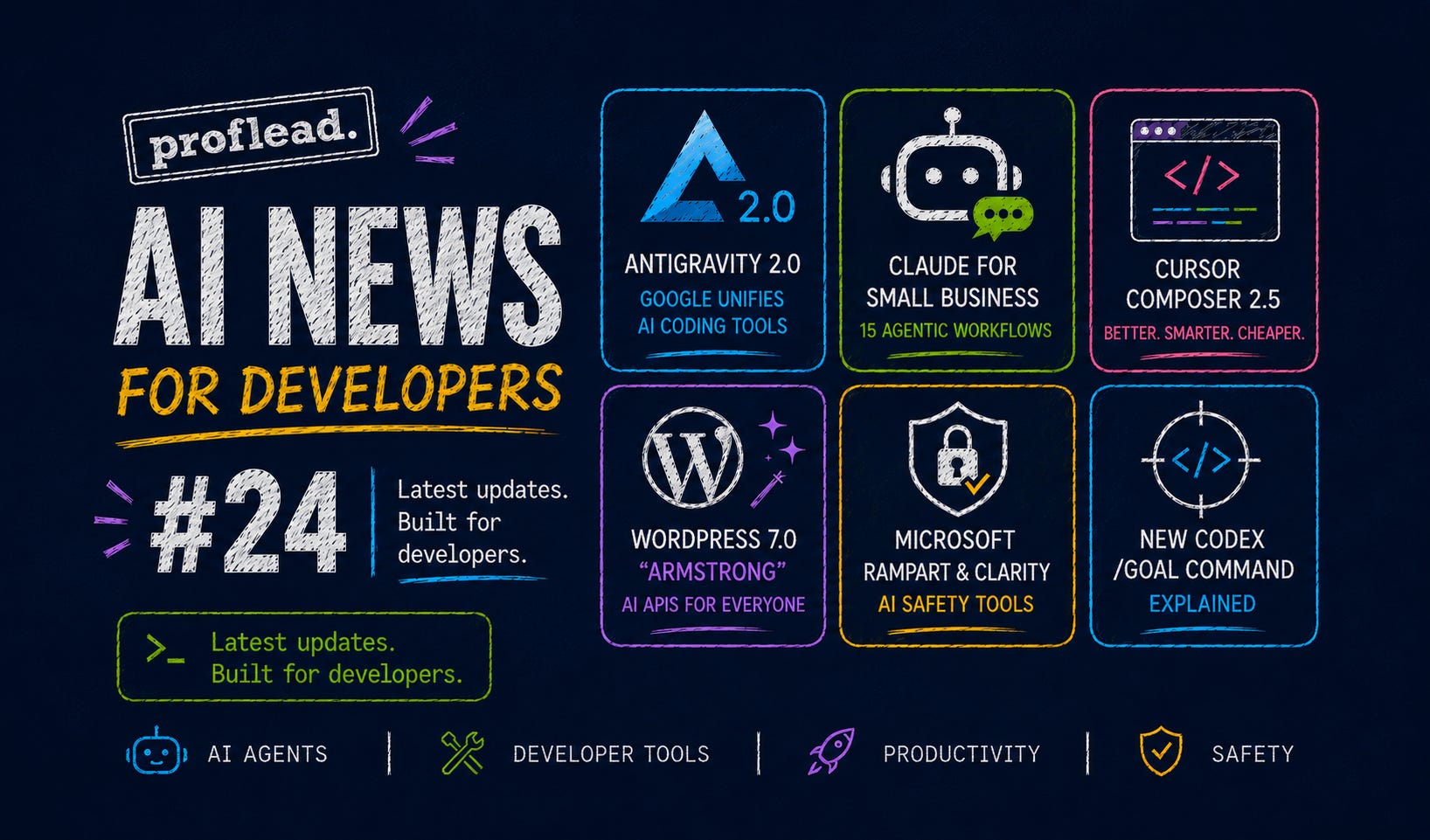
Hey, Devs! Vlad here! This issue covers Google I/O, Cursor 2.5, WordPress Armstrong, and new tools for testing agent behavior.
Google unifies AI coding tools under Antigravity 2.0
Gemini CLI, Code Assist, and AI Studio into a single Antigravity 2.0 platform. The platform includes a desktop app and a CLI, integrates deeply with the Gemini Enterprise Agent Platform, and aims to unify agentic workflows across desktop, terminal, and cloud environments. Existing scripts and CI workflows will need to be migrated before the previous tools are deprecated on 18 June.
Read more: https://antigravity.google/blog/introducing-google-antigravity-2-0
Claude for Small Business launch
On 13 May, Anthropic launched Claude for Small Business, a suite of 15 pre‑built agentic workflows that integrate with QuickBooks, PayPal, HubSpot, and other services. The initiative aims to close the AI adoption gap for small businesses by providing ready‑to‑use automations.
Read more: https://www.anthropic.com/news/claude-for-small-business
Cursor Composer 2.5
Cursor released version 2.5 of its coding agent. Composer 2.5, built on Moonshot’s Kimi K2.5 checkpoint, offers significant improvements in handling long-running coding tasks, follows complex instructions more reliably, and uses targeted reinforcement learning to correct specific mistakes. The model is priced at $0.50 per million input tokens and $2.50 per million output tokens (fast variant $3.00/$15.00) and positions itself as lower‑cost than other frontier models.
Read more: https://cursor.com/blog/composer-2-5
WordPress 7.0 “Armstrong”
The official WordPress release introduced a major upgrade named after Louis Armstrong. WordPress 7.0 lays “the foundation for AI across the WordPress experience” and provides a new AI Client and Abilities API that can communicate with generative models.
Read more: https://wordpress.org/news/2026/05/armstrong/
Microsoft open‑sources Rampart and Clarity
To operationalize AI agent safety, Microsoft released two open-source tools. Rampart, built on PyRIT, converts red‑team findings into repeatable tests run during development and deployment to catch prompt injection, unsafe tool use, and privilege escalation. Clarity guides engineers through structured conversations about agent behavior, permissions, and trust boundaries, storing decision logs as Markdown in the repository. These tools aim to make continuous AI safety engineering part of standard DevOps.
Learn more:
The New Codex /goal Command Explained
In this video, I show how to use Codex’s /goal command for longer coding sessions, write a goal, and decide when to use it instead of a regular prompt.
Watch on YouTube: Codex /goal
See you next week! Cheers, proflead! ;)