
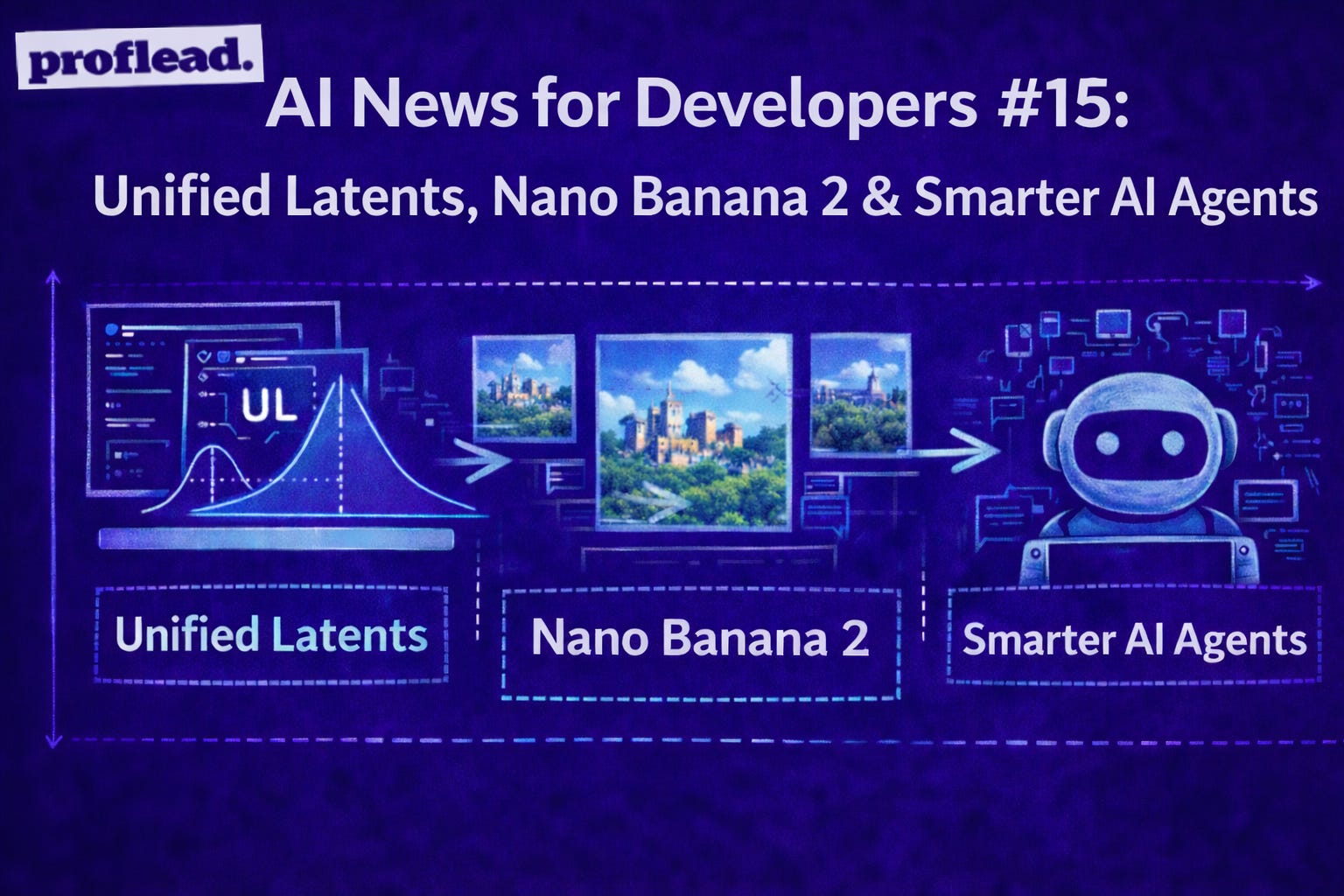
Hey devs! AI is moving fast again this week. We’re seeing better model efficiency (Unified Latents), faster and smarter image generation (Nano Banana 2), higher usage limits for Codex, and a new Microsoft framework that helps AI agents manage multiple tasks at once.
Google DeepMind’s Unified Latents (UL)
DeepMind introduced a new diffusion-model framework that jointly trains the encoder, diffusion prior, and decoder to produce high-quality images and video with less compute. UL uses a deterministic encoder with fixed Gaussian noise and a two-stage training process.
Read more: https://arxiv.org/abs/2602.17270
Nano Banana 2 (Gemini 3.1 Flash Image)
Google’s latest image generator combines the high-fidelity capabilities of Nano Banana Pro with Gemini Flash speed. It draws on Gemini’s real-world knowledge to improve accuracy, supports precise text rendering and translation, and keeps up to five characters and 14 objects consistent across panels.
Read more: https://blog.google/innovation-and-ai/technology/ai/nano-banana-2/
Codex with 2× usage limits
OpenAI’s Codex coding agent is included with ChatGPT Plus, Pro, Business, and Enterprise/Edu subscriptions-and is temporarily available on Free and Go plans-with double the usual rate limits for a limited time.
Read more: https://help.openai.com/en/articles/11369540-using-codex-with-your-chatgpt-plan
Microsoft’s CORPGEN
To tackle multitasking, Microsoft Research created the Multi-Horizon Task Environment (MHTE) benchmark. In MHTEs, traditional agents’ completion rates dropped from 16.7 % to 8.7 % as task load increased. CORPGEN introduces “digital employees” with hierarchical planning, isolated sub-agents, tiered memory, and adaptive summarization. These mechanisms raised task completion rates to 15.2% from 4.3% for the baseline at 46 concurrent tasks (~3.5× improvement). It shows how system design, rather than model size, can dramatically improve multi-task agent performance.
Read more: https://www.microsoft.com/en-us/research/blog/corpgen-advances-ai-agents-for-real-work/
This AI Uses Spaced Repetition to Help You Remember More (Sponsored)
In this video, I introduce Recall, an AI-powered knowledge base that uses spaced repetition and active recall to help you remember more of what you save.
Watch on YouTube: Learn Faster and Retain More with Recall
See you next week! Cheers, proflead! 😉